Greenie Get the app
Hoya care
Hoya carnosa · Apocynaceae
Also called Wax plant, Porcelain flower, Honey plant.
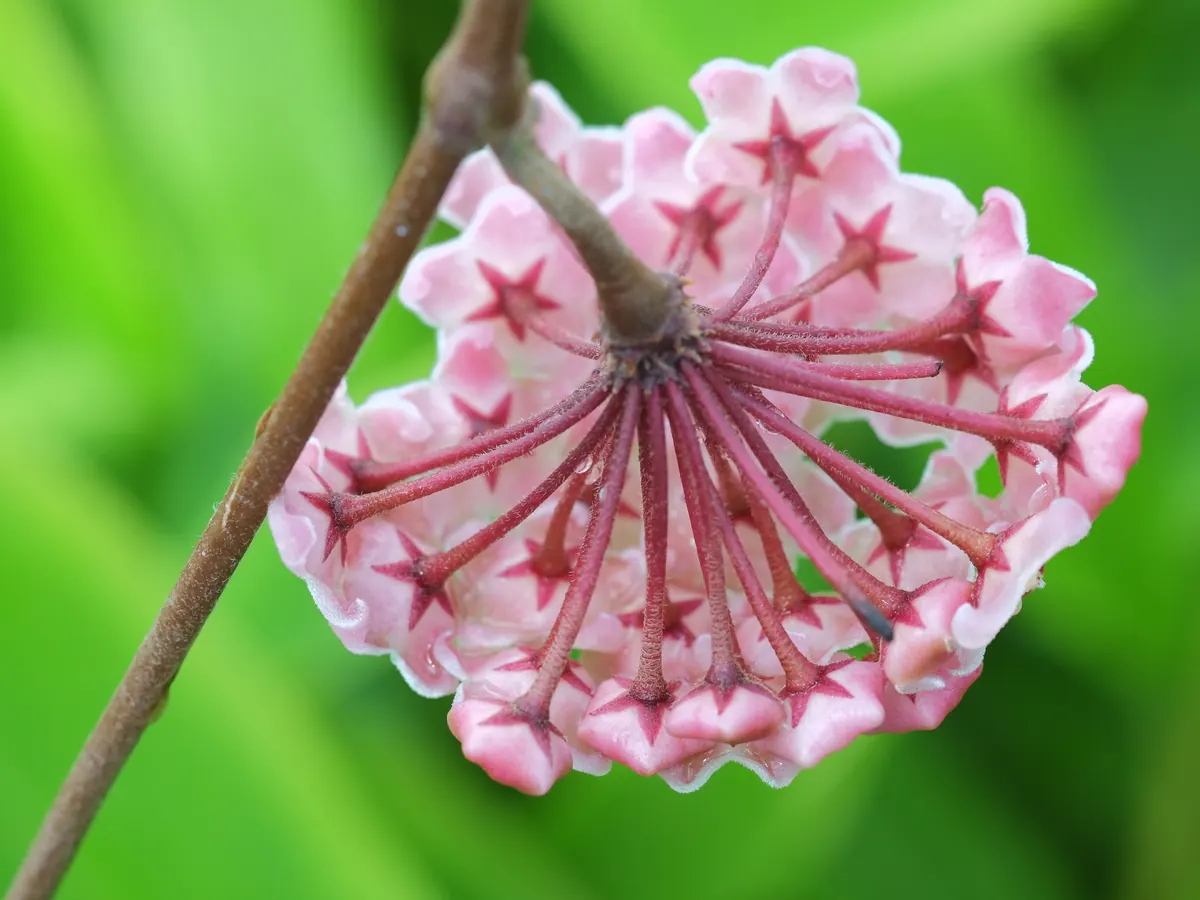
An evergreen climbing vine from southern China, the eastern Himalaya, Japan, Taiwan and northern Indochina, where it grows on trees rather than in the ground. Its thick, waxy leaves store water, and mature plants carry round clusters of scented, star-shaped flowers in white or pale pink with a red centre. Indoors it trails from a basket or climbs a small hoop to around 1 m.
Light
Bright IndirectWatering
WeeklyDifficulty
EasyPets
Non-toxic to cats and dogsHeight indoors
0.6-1.2 m
Growth
Fast
Temperature
16-24 °C
Not below 10 °C
HumidityUnconfirmed
40% - 60%
Average room humidity
Soil pHUnconfirmed
6.0-7.5
Neutral soil
Native to
- China
- Bhutan
- India
- Japan
- Laos
- Myanmar (Burma)
- Taiwan
Through the year
Let the mix get almost dry, then water well and let it drain. From October to February water less, but do not let the pot dry out completely. Use water at room temperature.
-
Spring
WeeklyRepot if needed, start feeding again and give it a support to climb.
-
Summer
WeeklyMain flowering time; keep the pot in place and the mix evenly moist.
-
Autumn
Every 2 weeksCut back on water and feeding as growth slows.
-
Winter
Every 2 weeksKeep it cooler and on the dry side, but above 10 °C at night and away from radiators.
Feeding
Every 2 weeks in spring and summer. Light doses of a balanced, preferably urea-free orchid feed. Drop to once a month at most in autumn and winter, and wait 5 to 6 weeks after repotting.
Care tips
-
Leave the old flower stalks
New clusters grow from the same short spurs year after year, so never cut them off after flowering.
-
Use a chunky mix
In the wild it grows on bark; a mix of orchid bark, potting compost and perlite drains the way it likes.
-
Keep it a little pot-bound
Repot in spring only when roots fill the pot, moving up just a few centimetres.
-
Give it plenty of light to flower
Bright light, even a little gentle sun, is what gets it to bloom; young plants often need 2-3 years first.
-
Prune lightly
Trim weak or crowded shoots in late winter. It does not recover well from hard cutting back.
Common problems
-
Root rot
What you seeLeaves go soft and yellow and the mix stays wet for days.
What to doRepot into a coarse, bark-based mix in a pot only slightly larger than the roots, and water only when the mix is nearly dry.
-
Mealybugs
What you seeWhite, cottony clumps on stems, leaf joints and flower stalks.
What to doWipe them off with a cotton swab dipped in rubbing alcohol and check again every week.
-
Dropped flower buds
What you seeBuds turn yellow and fall before they open.
What to doDo not move or turn the pot once buds form, and keep watering steady.
Pets
Is hoya safe for cats and dogs?
Non-toxic to cats and dogs. Listed by the ASPCA as non-toxic to cats and dogs (entries 'Honey Plant' and 'Wax Plant').
Good to know
-
Hoya is named after Thomas Hoy, who looked after the Duke of Northumberland's gardens in the late 1700s.
-
Its stems twine counterclockwise around thin supports.
-
Each flower cluster can hold 10 to 30 small waxy stars, and the flowers can drip a sticky nectar.