Greenie Get the app
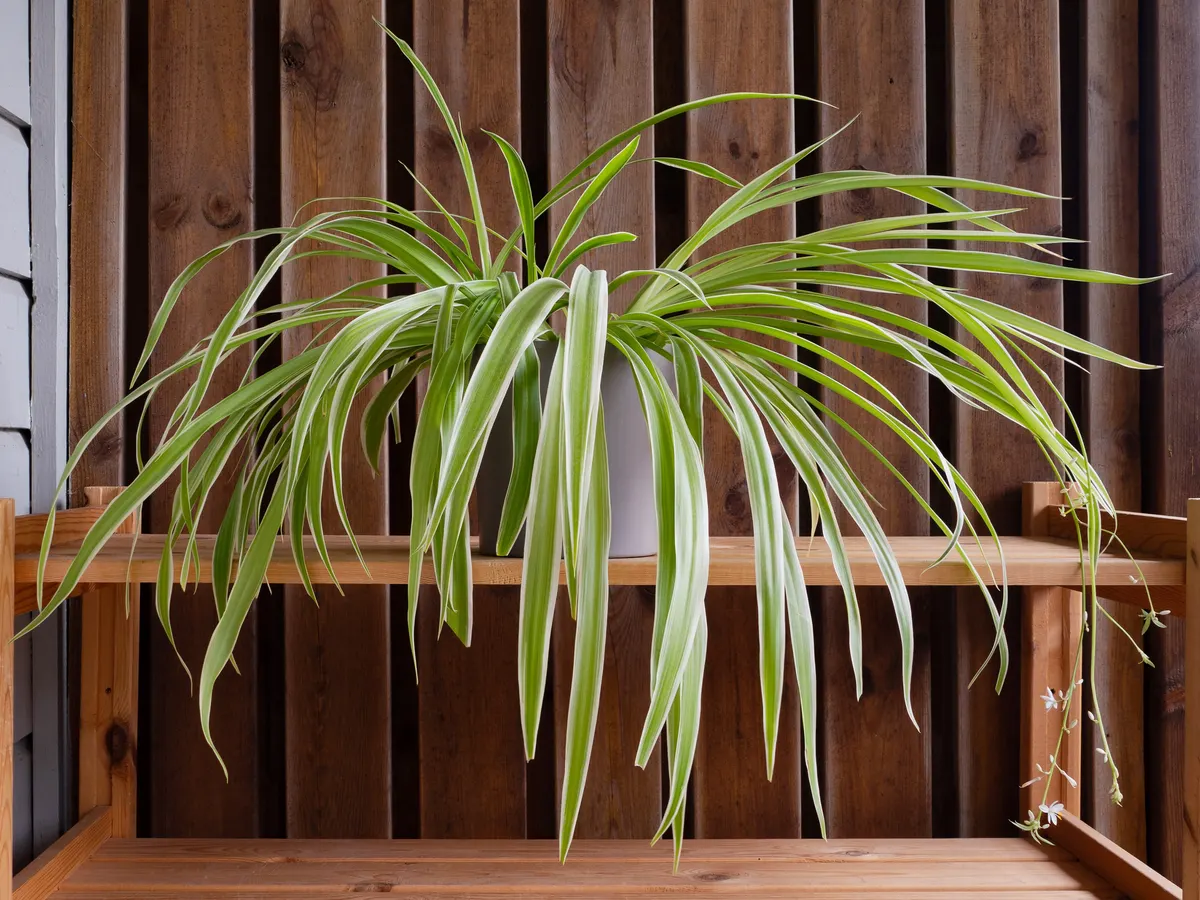
Spider plant care
Chlorophytum comosum · Asparagaceae
Also called Ribbon plant, Spider ivy.
A grassy perennial from tropical and southern Africa with arching, often white-striped leaves. Mature plants send out wiry stems that carry small white flowers and baby plants, which make it a classic for hanging baskets. It is easy to grow, quick to multiply and safe around cats and dogs.
Light
Bright IndirectWatering
WeeklyDifficulty
EasyPets
Non-toxic to cats and dogsHeight indoors
30-60 cm
Growth
Fast
Temperature
13-24 °C
Not below 7 °C
Humidity
40% - 60%
Average room humidity
Soil pH
6.0-7.5
Neutral soil
Native to
- Burundi
- Cameroon
- Côte d’Ivoire
- Ethiopia
- Equatorial Guinea
- Kenya
- Liberia
- Malawi
- Mozambique
- Nigeria
- Sierra Leone
- South Sudan
- Eswatini
- São Tomé & Príncipe
- Tanzania
- Uganda
- South Africa
- Zambia
- Zimbabwe
Through the year
Let the top of the soil dry briefly between waterings; water less in winter. Rain or filtered water helps prevent brown tips.
-
Spring
WeeklyRepot or divide crowded plants and start feeding.
-
Summer
WeeklyWater regularly and keep it out of hot direct sun.
-
Autumn
WeeklyShorter days trigger new plantlets; stop feeding.
-
Winter
Every 2 weeksMove it a little away from cold windows and water less.
Feeding
Every 6-8 weeks in spring and summer. Water-soluble houseplant fertilizer. Heavy feeding means fewer plantlets.
Care tips
-
Root the babies
Pin a plantlet onto a pot of moist mix while still attached and cut it free once it roots.
-
Divide before it bursts
The thick tuberous roots can crack plastic pots, so repot or divide when they fill the container.
-
Keep it out of midday sun
Direct sun at noon scorches the leaves; a bright spot a little back from the window is best.
-
Trim tired leaves
Cut off yellow leaves and brown tips to keep it tidy.
Common problems
-
Brown leaf tips
What you seeThe ends of the leaves turn brown and dry.
What to doWater with rain or filtered water, avoid overfeeding and do not let the soil dry out completely.
-
Root rot
What you seeLeaves yellow and the base feels soft while the soil stays wet.
What to doRepot into a fast-draining mix and water only when the top of the soil is dry.
-
Spider mites
What you seePale stippling on the leaves and fine webbing between them.
What to doRinse the plant in the shower and treat with insecticidal soap until the mites are gone.
Pets
Is spider plant safe for cats and dogs?
Non-toxic to cats and dogs. Listed by the ASPCA as non-toxic to cats and dogs.
Good to know
-
Plantlets form after the plant has had about three weeks of long, uninterrupted nights.
-
Its fleshy roots store food and water, which is why it bounces back from neglect.