Greenie Get the app
Chinese money plant care
Pilea peperomioides · Urticaceae
Also called Pancake plant, UFO plant, Missionary plant.
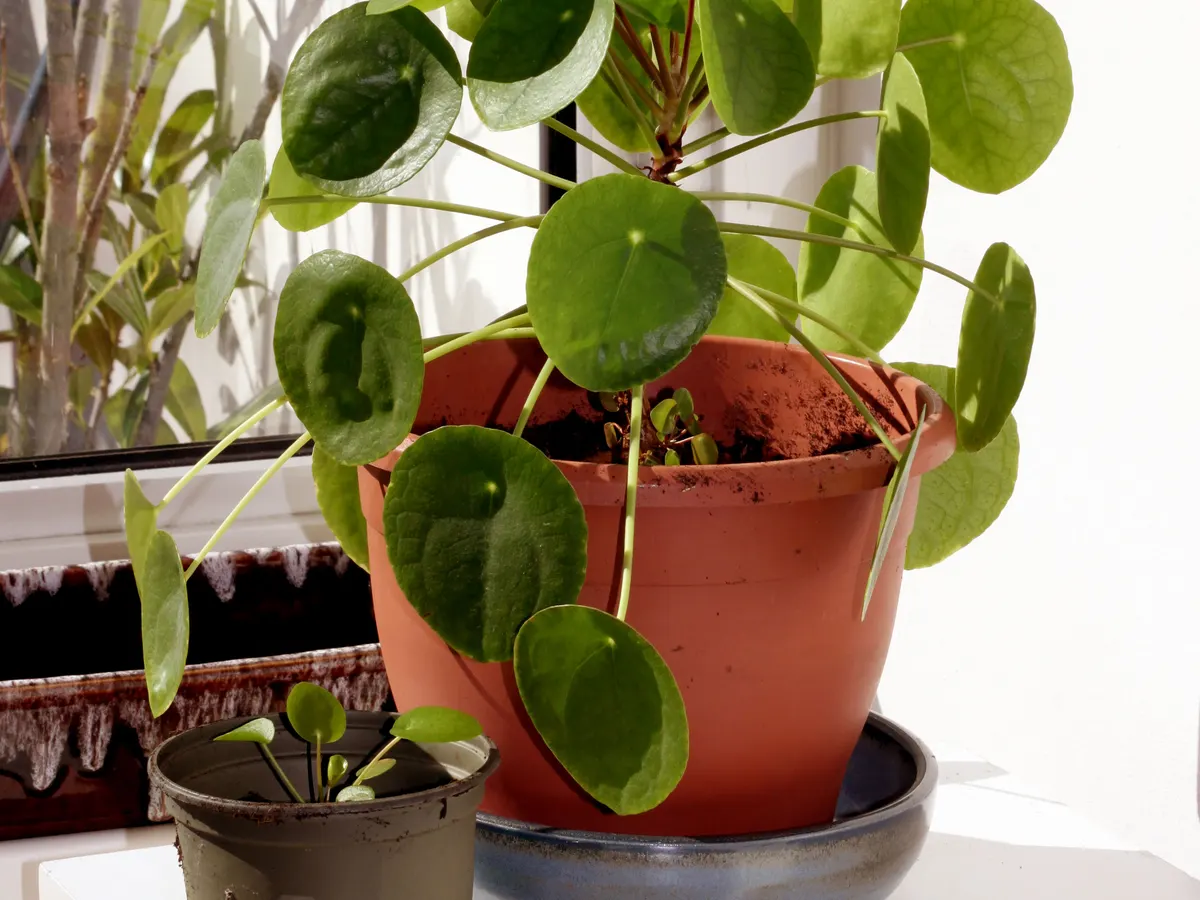
A compact plant from the cool, shaded mountains of south-western China, with round, glossy leaves held on long stalks attached near the centre of each leaf. It is easy to grow in bright, indirect light and produces small offsets that can be potted up as new plants.
Light
Bright IndirectWatering
WeeklyDifficulty
EasyPets
Not confirmedHeight indoors
20-30 cm
Growth
Fast
TemperatureUnconfirmed
15-24 °C
Not below 10 °C
Humidity
40% - 60%
Average room humidity
Soil pH
6.0-7.0
Slightly acidic soil
Native to
- China
Through the year
Water when the top 2 to 3 cm of soil are dry; in winter that is usually every 2 weeks.
-
Spring
WeeklyBest time to repot and separate offsets.
-
Summer
WeeklyWater more often and keep it out of hot direct sun.
-
Autumn
Every 2 weeksStop feeding and let the soil dry more between waterings.
-
Winter
Every 2 weeksKeep it above 10 °C and water sparingly.
Feeding
Every 4 weeks in spring and summer. Balanced liquid fertilizer at half strength. Do not feed in winter.
Care tips
-
Turn the pot
Rotate it weekly so it grows evenly instead of leaning.
-
Pot up the offsets
Cut pups away from the base with some roots once they are a few cm tall.
-
Keep leaves dry
Water at the soil line; wet foliage can lead to leaf spots.
-
Avoid temperature swings
Keep it away from radiators and cold drafts.
Common problems
-
Leggy, leaning stems
What you seeThe stem stretches and the plant leans hard toward the window.
What to doMove it to a brighter spot and turn the pot a quarter turn every week.
-
Drooping, yellow leaves
What you seeLower leaves yellow and soften while the soil stays wet.
What to doLet the soil dry further between waterings and check that the pot drains.
-
Scale insects
What you seeSmall brown bumps on stems and leaf undersides, sometimes with sticky residue.
What to doScrape them off or dab with alcohol, then treat with insecticidal soap.
Pets
Is chinese money plant safe for cats and dogs?
Not confirmed. Pilea peperomioides is not on the ASPCA toxic and non-toxic plant lists.
Good to know
-
The leaf stalk joins each leaf near its middle, so the leaves look like small discs floating on stems.
-
In the wild it grows only in parts of Sichuan and Yunnan in China.