Greenie Get the app
Staghorn fern care
Platycerium bifurcatum · Polypodiaceae
Also called Elkhorn fern, Common staghorn fern, Antelope ears.
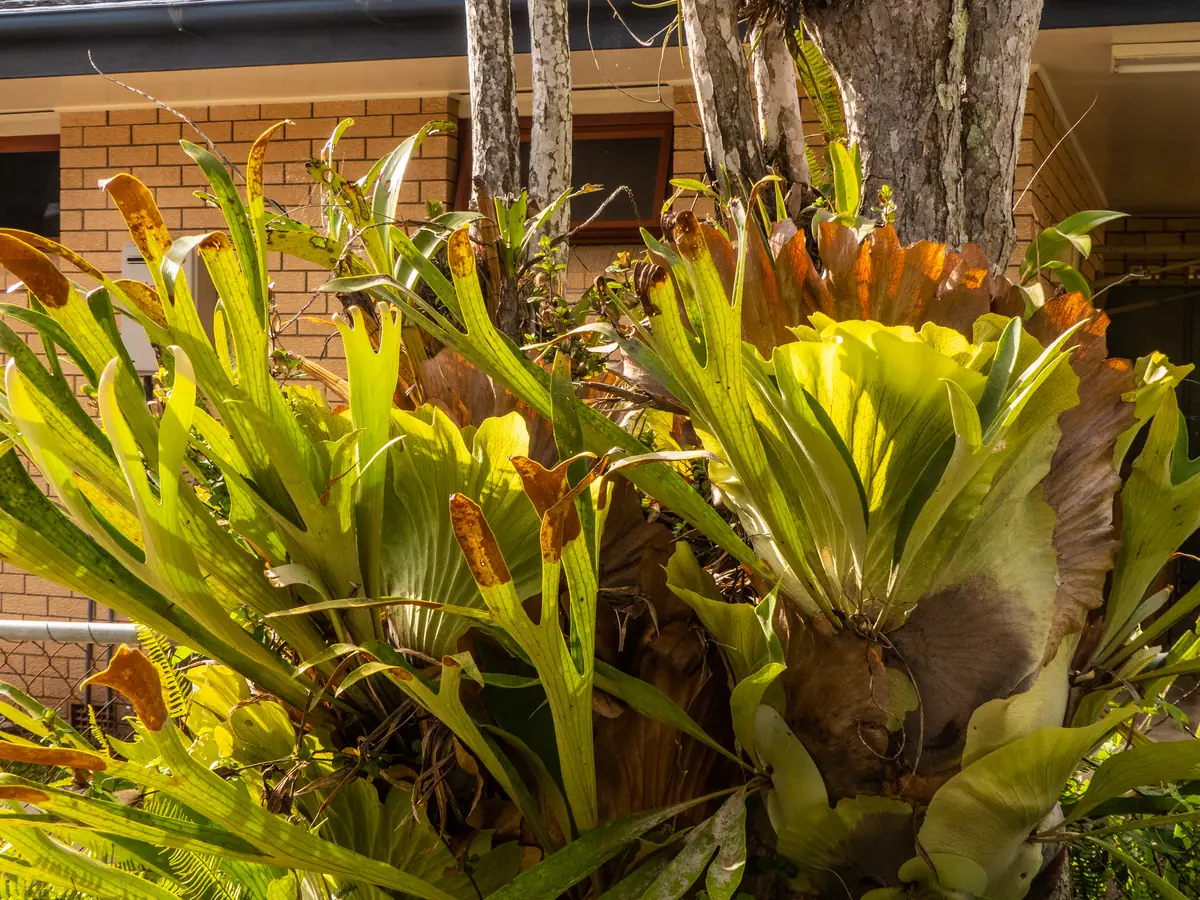
An epiphytic fern from eastern Australia, New Caledonia and parts of Indonesia that grows on tree trunks. Flat shield fronds hug the mount and cover the roots, while grey-green, felt-covered fronds fork like antlers and reach 60-90 cm indoors. It is usually grown mounted on a board or in a hanging basket rather than in a pot.
Light
Bright IndirectWatering
WeeklyDifficulty
MediumPets
Non-toxic to cats and dogsHeight indoors
0.6-0.9 m
Growth
Slow
Temperature
10-22 °C
Not below 10 °C
HumidityUnconfirmed
60% - 80%
Likes humid air
Soil pHUnconfirmed
5.5-7.0
Slightly acidic soil
Native to
- Australia
- Indonesia
- New Caledonia
Through the year
Soak the root ball or mount when it is nearly dry, then let it drain; never let it dry out completely. In warm, dry spells that usually means a soak each week; in cool or overcast weather it needs one far less often.
-
Spring
WeeklyStart feeding and remount it if the shields have grown past the edge of the board.
-
Summer
WeeklyWater weekly and keep the humidity high; it can hang in a shaded porch.
-
Autumn
Every 2 weeksCut back watering and feeding as growth slows.
-
Winter
Every 2 weeksKeep it in bright, indirect light, above 10 °C at night and away from radiators; soak it only when the mount is nearly dry.
Feeding
Every 4 weeks in spring and summer. Balanced liquid fertilizer (equal N-P-K) for young plants; mature plants need it only once or twice a year.
Care tips
-
Mount it
Tie the root ball onto a board, cork slab or bark with sphagnum moss behind it, using plastic strips, nylon or non-copper wire.
-
Leave the brown shields
The flat shield fronds turn brown and papery with age; that is normal, and they protect the roots, so do not remove them.
-
Soak, don't sprinkle
Dunk the mount or root ball in water for a few minutes, keeping the antler fronds dry, then let it drain.
-
Share the pups
Small plantlets form around the base; detach them with some roots to start new plants.
Common problems
-
Rot from overwatering
What you seeThe base turns dark and soft and the fronds collapse even though the mount is wet.
What to doLet the mount get close to dry before the next soak; a slightly wilted fern recovers fast, a rotted one does not.
-
Scale insects
What you seeSmall, raised brown bumps fixed to the fronds, often on the undersides; they look like tiny shells, unlike the flat, fuzzy felt that covers the fronds.
What to doPick them off carefully and treat with insecticidal soap, avoiding harsh insecticides.
-
Brown felt under the tips
What you seeRusty-brown patches appear on the underside of the antler fronds.
What to doNo fix needed: these are spore patches and a sign of a mature, healthy plant.
Pets
Is staghorn fern safe for cats and dogs?
Non-toxic to cats and dogs. Listed by the ASPCA as non-toxic to cats and dogs (common staghorn fern).
Good to know
-
The genus name comes from the Greek for flat horn, and bifurcatum means twice forked, both describing the antler fronds.
-
Its shield fronds trap falling leaves against the tree trunk, building a small compost heap that feeds the plant.
-
It is an epiphyte, not a parasite: it only uses the tree for support.