Greenie Get the app

String of hearts care
Ceropegia woodii · Apocynaceae
Also called Rosary vine, Chain of hearts, Hearts entangled.
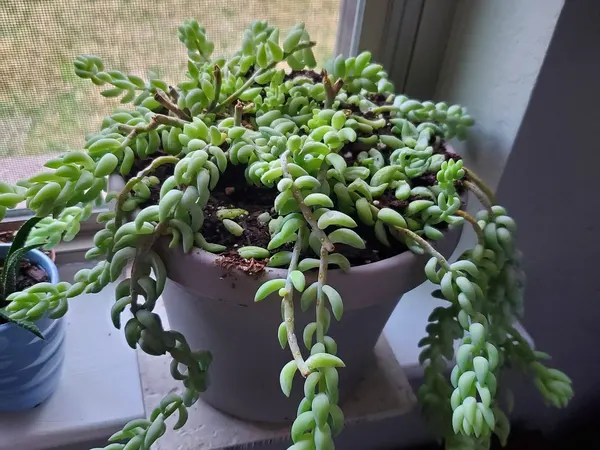
A trailing succulent vine from southern Africa, from Zimbabwe and Mozambique to eastern South Africa. Thin purplish stems carry pairs of small, heart-shaped leaves marbled with silver, plus little bead-like tubers that can root into new plants. It is easy to grow in a hanging pot as long as it gets good light and is not overwatered.
Light
Bright IndirectWatering
Every 2 weeksDifficulty
EasyPets
Not confirmedHeight indoors
0.3-0.9 m
Growth
Fast
TemperatureUnconfirmed
16-27 °C
Not below 16 °C
HumidityUnconfirmed
30% - 50%
Fine in dry rooms
Soil pHUnconfirmed
6.0-7.0
Slightly acidic soil
Native to
- South Africa
- Eswatini
- Mozambique
- Zimbabwe
Through the year
Let the mix dry out completely, then water deeply and let the excess drain. It copes with dry soil far better than wet soil. Water even less during its winter rest.
-
Spring
Every 2 weeksRepot if it is overcrowded and start feeding lightly.
-
Summer
Every 2 weeksMain growing and flowering time: water when the mix is dry and give it bright light.
-
Autumn
Every 2 weeksBring it indoors before frost if it summered outside and start to water less.
-
Winter
MonthlyRest period: keep it above 16 °C, water sparingly and skip feeding.
Feeding
Monthly at most in spring and summer. Houseplant fertilizer at half strength. Do not feed during the winter rest.
Care tips
-
Grow it in a gritty mix
Use cactus and succulent mix or add plenty of coarse sand or perlite so water drains fast.
-
Root the beads
Press a bead on a stem into the soil of another pot, keep it slightly moist and cut it free once it has rooted.
-
Don't rush to repot
It likes being crowded; repot only when needed, in spring before growth starts.
-
Watch the sun
A west- or south-facing window works, but harsh sun through glass can scorch the leaves; harden it off slowly if it goes outside.
Common problems
-
Root rot
What you seeLeaves turn yellow and stems go soft while the mix stays wet.
What to doLet the mix dry out completely before watering, and repot into a gritty cactus mix if it stays soggy.
-
Long gaps between leaves
What you seeNew stems are thin with widely spaced, pale green leaves.
What to doMove it to a brighter spot; in good light the leaves are closer together and more strongly marbled.
-
Mealybugs
What you seeWhite cottony clumps on the stems and leaf joints.
What to doDab them off with rubbing alcohol on a cotton swab and check again every week.
Pets
Is string of hearts safe for cats and dogs?
Not confirmed. The ASPCA has no entry for this species or genus. It lists related plants in the same family (Apocynaceae), such as wax plant (Hoya carnosa) and carrion flower (Stapelia), as non-toxic to cats and dogs.
Good to know
-
Its small tube-shaped flowers trap visiting flies with downward-pointing hairs and release them, dusted with pollen, once the hairs wither.
-
The genus name comes from Greek words for wax and fountain, after the look of the flowers.
-
The species is named after John Medley Wood, who collected plants in southern Africa.